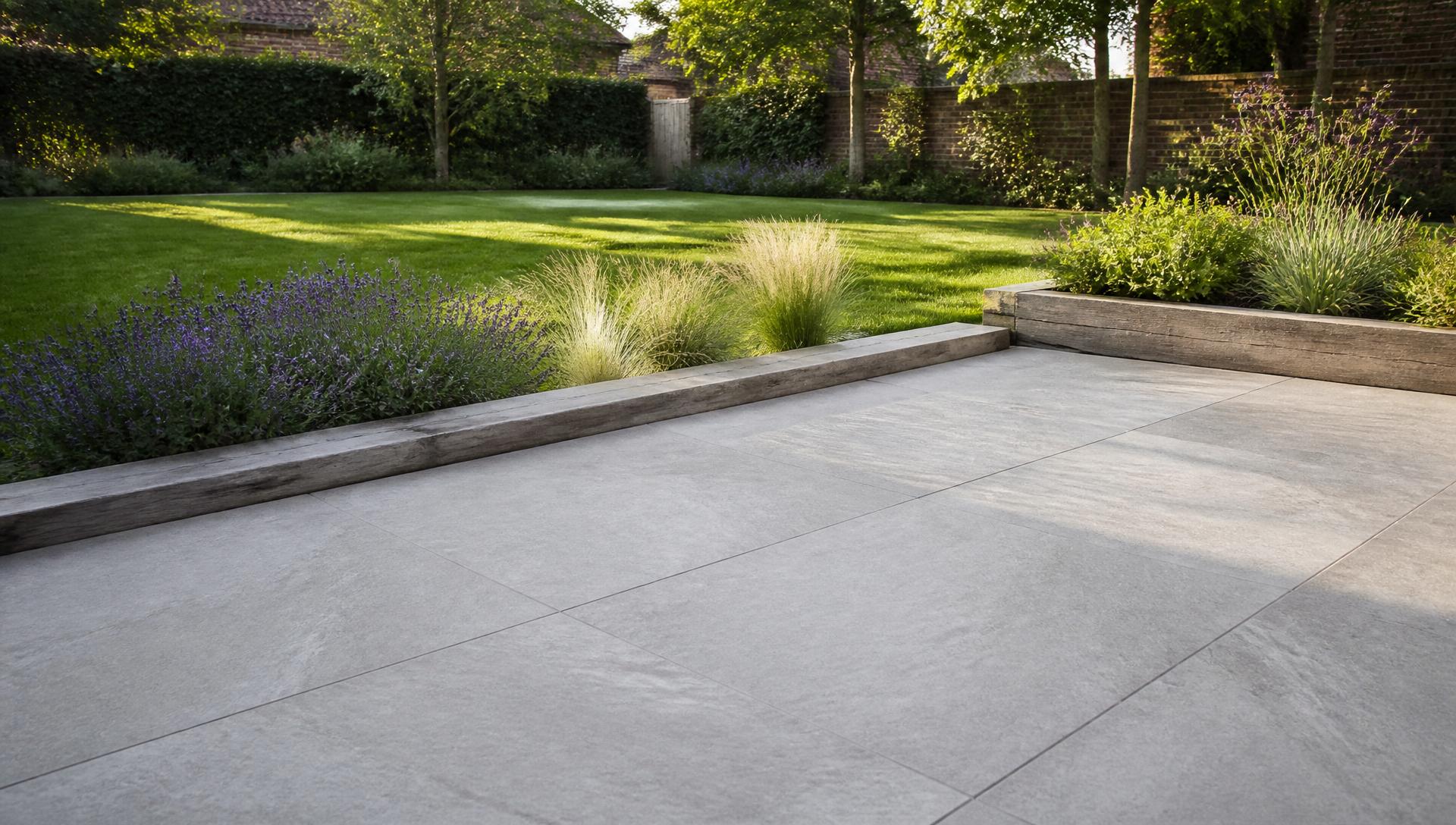
Patios & Landscapingin King's LynnHard landscaping done on proper groundworks
A patio should sit flat, shed water away from the house and still be that way in ten years. The market is full of patios laid on sand and hope. Ours are laid on a proper compacted sub-base with a full mortar bed, correct falls, and drainage that actually goes somewhere.
£1M public liability insured Free site survey within 7 days Owner-managed by Jason, 25+ years on the tools
25+
Years experience
£1M
Public liability
7 days
To free survey
3 days
Written quote*
Fixed
Written pricing
Service overview
What's involved, explained plainly.
What it is
Hard landscaping covers patios, paths, steps, retaining walls, garden drainage, brick or block boundary walls, edging and the associated groundworks. It's the built structure of a garden, the elements that shape how it drains, how it's used and how long it lasts.
Who it's for
Homeowners upgrading tired existing patios, landscaping a new-build garden, replacing a lawn with a low-maintenance hard-surfaced entertaining area, or coordinating hard landscaping alongside a new extension or driveway.
When you need it
Any time except deep frost. Spring and autumn are the busiest and most weather-reliable seasons in Norfolk. Booking a survey early in the season helps secure a slot.
Why professional help matters
Patio failures are almost always down to the same three things: wrong or thin sub-base, spot-bedding instead of a full mortar bed, and no drainage plan. All three are avoidable if the job is treated as a groundworks job with a paving finish, which is how we approach it.
Ignore it and…
The cost of getting it wrong.
The five-day, cheap-price patio installer usually does the same things, scrape 100mm off, sand blinding, spot-bed the slabs, brush kiln-dried sand in the joints and leave. It looks fine in July and starts moving by January.
Rocking and sunken slabs
Spot-bedded slabs on thin sub-base rock underfoot within a season, then sink at the corners as water tracks under them and washes the base out.
Water back to the house
Patio laid with fall towards the house or without a drainage plan puts standing water against the wall, damp, staining, and over time cavity issues.
Moss, staining and joint failure
Poor jointing material, incorrect brushing-in and no compaction pass mean joints wash out fast, weeds seed in and moss establishes.
Cracked or split slabs
Cheap Indian sandstone laid without a full mortar bed cracks under load. Once split, individual replacement rarely matches the weathered colour of the rest.
Common mistakes we see
Spot-bedding slabs on five dots of mortar
Sub-base of 50–75mm instead of the 100–150mm the job needs
Laying towards the house instead of away
Using kiln-dried sand joints on wide-gap traditional slabs
No linear drainage where the patio meets a door threshold
the owner walks the garden, checks levels, drainage options, existing structures and how you want to use the space, then discusses realistic material choices.
02
Fixed written quote
Itemised quote in 3 working days, dig depth, muck-away, sub-base, edge detailing, drainage, paving material, jointing and reinstatement all separately listed.
03
Excavation & sub-base
Existing surface removed, dug to design depth, geotextile where required, MOT Type 1 sub-base whacked in 100mm lifts to correct compaction.
04
Full mortar bed & drainage
Slabs laid on a full mortar bed to the correct fall, drainage installed where required (linear channel at door thresholds, downpipe run-offs).
05
Joint & clean
Joints filled with the appropriate jointing compound for the slab and gap width, compacted, patio washed down and workmanship guarantee issued in writing.
Benefits
What you actually get for your money.
No rock, no rattle
Full mortar bed on a proper sub-base means slabs stay exactly where they were laid, no rocking, no sinking corners.
Water goes away, not towards
Falls calculated and set from the start, with drainage installed at any door threshold or low point. Standing water designed out.
Joints that stay put
Correct jointing material for the slab type, brush-in, slurry, or fully-mortared, compacted and finished so it doesn't wash out in one wet week.
Coordinated with the house
Patios laid to the right level against damp course lines, with linear drainage at thresholds so external levels don't compromise internal damp protection.
One team, one contract
Groundworks and paving by the same crew, no arguments about whose bit failed if something moves.
Workmanship guarantee
Written workmanship guarantee, backed by our £1M public liability insurance.
In detail
Materials, methods and the situations we cover.
Natural stone patios
Indian sandstone, limestone, granite and porcelain-effect natural stone all lay differently and want different jointing. We match the laying method to the slab, and we don't use spot-bedding on any of them.
Indian sandstone in riven, sawn or brushed finishes
Yorkstone-effect and limestone patios
Granite setts and edging
Full mortar bed on every slab, never spot-bedded
Porcelain paving
Porcelain has taken over the premium patio market, dimensionally accurate, colour-stable, and low maintenance. Laying method is different (primer, full mortar bed, slurry jointing), and we install to the manufacturer's system correctly.
20mm outdoor porcelain paving
Slurry primer bond coat
Full mortar bed to manufacturer's spec
Slurry-grouted joints
Concrete block paving and setts
Not just for driveways, block paving and setts make hard-wearing paths, courtyard patios and edging. Laid on the same sub-base and edge-restraint principles as our driveway work.
Standard and permeable block paving
Cobble effect concrete setts
Concrete-haunched edge restraints
Retaining walls, steps and boundary work
Retaining walls, steps between levels and boundary walls are structural elements of hard landscaping. Built on proper footings, with the correct drainage behind retaining walls and safe step dimensions to Building Regulations Part K.
Retaining walls with drainage and geotextile behind
Steps to safe rise-and-going dimensions
Brick, sleeper or block retaining structures
Coping stones and finishes to shed water
Garden drainage and coordination
Water is what kills gardens, puddling lawns, damp against the house, patios that stream in a downpour. We install linear drains at thresholds, French drains where lawns won't drain, and connect run-offs to soakaways sized properly.
Linear drainage at patio-to-door thresholds
French drains in wet lawn areas
Soakaway crates sized to percolation
Downpipe run-offs coordinated with patio falls
FAQ
The questions homeowners actually ask.
Straight answers on cost, timelines, guarantees and how the job runs. If yours isn't here, call Jason on 07880 333321.
How much does a new patio cost in King's Lynn?
Typical natural stone patios in West Norfolk start around £100–£140 per m² fully installed with proper sub-base and full mortar bed. Porcelain patios usually run £140–£190 per m². Prices vary with dig depth, drainage requirements, edge complexity and material choice, free survey and fixed written quote in 3 working days.
How long does a patio take to lay?
A typical residential patio is usually 5–10 working days from dig to jointing. Bigger patios, retaining walls, steps and drainage runs take longer, your quote includes a target programme.
Do I need planning permission for a patio?
For most residential patios in existing gardens, no. Exceptions can apply on listed buildings, in conservation areas, or where the patio raises levels significantly. We'll flag anything worth checking at survey stage.
What's the right way to lay a patio?
On a properly compacted sub-base (typically 100–150mm of MOT Type 1), each slab bedded on a full mortar bed, laid to a fall away from the house, and jointed with the correct jointing material for the slab and gap. Spot-bedding on five dots of mortar is what causes almost all patio failures.
Can you install porcelain patios?
Yes. Porcelain has a different installation system (primer, full mortar bed, slurry joint) and is a favourite of ours because when it's laid right it stays right, dimensionally accurate and colour-stable for years.
Do you handle drainage as part of the job?
Yes. Every patio quote includes the drainage strategy, falls, linear channels at door thresholds where needed, and soakaway or downpipe run-off connections. It's not an extra bolted on later.
Can you build retaining walls and steps?
Yes. Retaining walls, garden steps and small structural landscaping features are regular work. Built on proper foundations, with drainage behind retaining walls and safe step dimensions.
What guarantee do I get on the patio?
Written workmanship guarantee on every patio installation, backed by £1M public liability insurance. Manufacturer warranties on paving materials are handed over as well.
When's the best time of year for landscaping work?
Spring and autumn are ideal in Norfolk, reliable weather, mortar sets well, jointing goes down properly. Summer works too. Deep winter frost is the only real limitation, and we reschedule rather than lay work that won't set.
How quickly can you start?
Free survey within 7 days, written quote within 3 working days, and typical start on site 4–8 weeks from contract signing depending on season and workload.
Next step
Patios and landscaping done on proper groundworks, flat, dry, and still right in ten years.
Free site survey within 7 days. Written, itemised quote within 3 working days. Owner-managed by Jason personally, no call centre, no middlemen.